
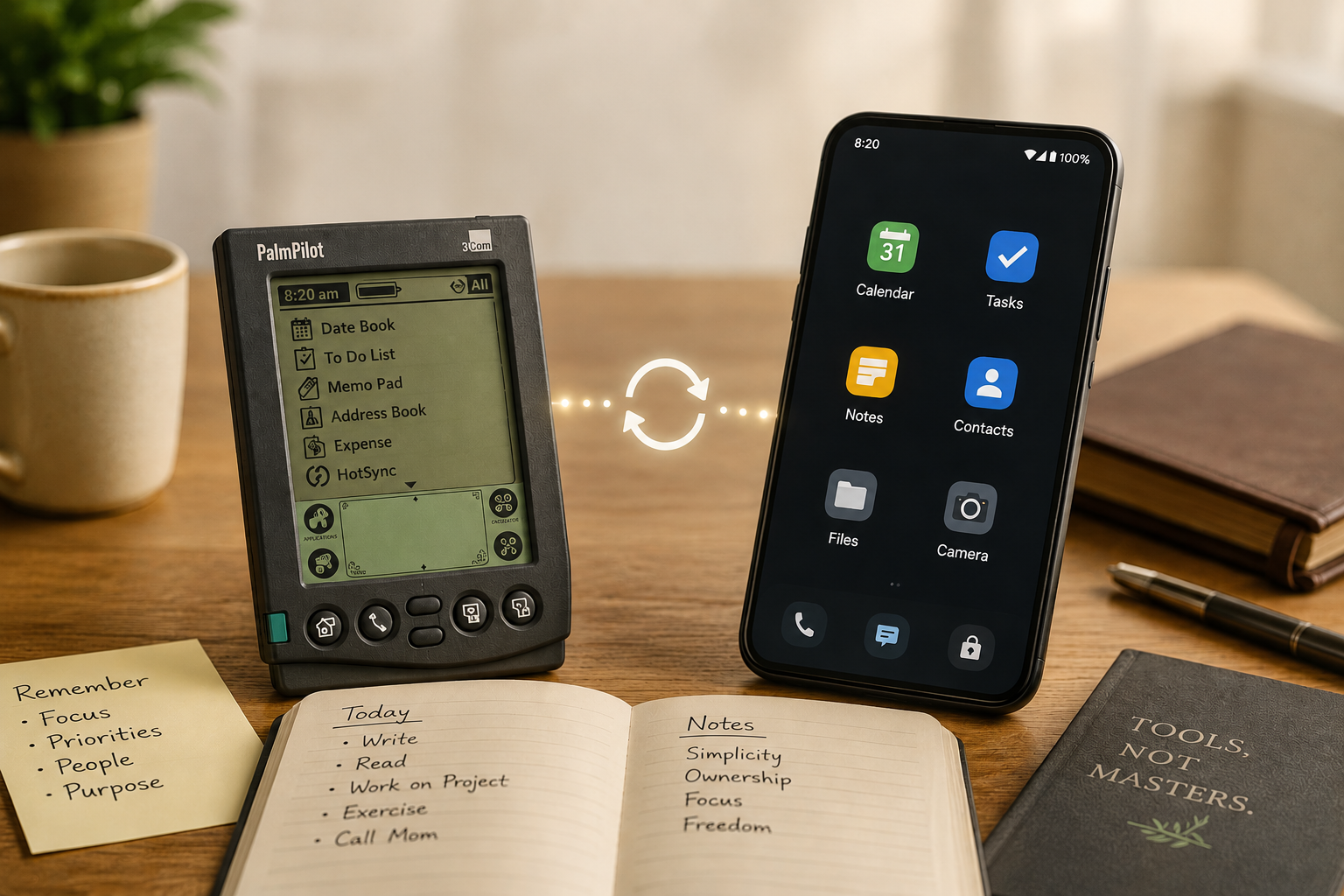
The modern smartphone is one of the most capable tools ever created. It serves as a camera, navigation system, library, music player, notebook, communication device, and portable computer that fits comfortably in a pocket. Yet despite its remarkable capabilities, many people have an uneasy relationship with it. We pick it up to accomplish a simple task and find ourselves distracted minutes later. We rely on it constantly, yet often feel that it demands more attention than it deserves. The problem is not that smartphones have become too powerful. It is that they have quietly changed from tools that serve our goals into products designed to shape our behavior.
It wasn’t always this way. Long before today’s app stores, recommendation algorithms, and endless notifications, devices like the Palm Pilot approached personal computing from a fundamentally different perspective. They existed to help people organize their lives, not occupy them. A Palm Pilot wasn’t trying to become the center of your day. It simply remembered what you told it, presented that information when you asked, and then patiently waited until you needed it again. Looking back, I don’t miss the hardware nearly as much as I miss the assumptions that guided its design.
Those assumptions are worth revisiting because they reveal that many of the frustrations we associate with modern technology are not inevitable. They are the result of design choices. Palm OS assumed your attention was valuable, your information belonged to you, and the device’s highest purpose was to help you accomplish something beyond the screen. Modern smartphones can still do those things, but they rarely encourage them by default. Recovering that older philosophy may be one of the simplest ways to build a healthier relationship with the technology we already own.
The Smartphone Changed Its Job
The original purpose of a personal digital assistant was remarkably straightforward: keep track of the information that people couldn’t easily carry in their heads. Appointments, contacts, notes, shopping lists, and reminders were stored in a device that was available whenever you needed it. The software was focused, responsive, and intentionally limited. Each application performed a specific function, and none of them competed for your attention once their work was done. The device was successful precisely because it faded into the background of everyday life.
Today’s smartphones still perform all of those functions, but they have accumulated a second job that often conflicts with the first. Beyond helping us communicate and stay organized, they have become platforms designed to maximize engagement. Notifications compete for our attention throughout the day. Applications encourage us to spend more time inside their ecosystems. Recommendation engines replace deliberate choices with endless streams of suggested content. The result is that a device originally intended to support our lives increasingly competes with them.
Recovering an Older Philosophy
If you’ve never owned a Palm Pilot, you might assume this is simply nostalgia for outdated hardware. It isn’t. The Palm Pilot had obvious limitations that no one would want to return to permanently. Its screen was tiny, wireless networking was primitive, and synchronizing data required placing the device in a physical cradle connected to your computer. Modern smartphones are objectively more capable in almost every measurable way.
What deserves to be recovered is not the hardware but the philosophy. Palm OS assumed that your attention was scarce, your data belonged to you, and the device existed to support your life rather than compete with it. Those assumptions influenced every aspect of its design. The applications were small because they focused on doing one thing well. The interface was uncluttered because it wasn’t trying to persuade you to open another app. Even synchronization reflected a different worldview. Your computer wasn’t merely a gateway to an online account; it was your digital home, and the handheld device was simply another trusted copy of your information.
None of those principles disappeared because they stopped working. They disappeared because a different business model emerged. Once smartphones became platforms for advertising, subscriptions, and engagement, it became profitable to maximize the amount of time people spent interacting with their devices. Features that once existed to reduce friction gradually evolved into features that increased dependence. Recognizing this shift is important because it reminds us that our current relationship with technology is not inevitable. It is the product of design decisions, many of which we are free to reconsider.
Building a Palm-Inspired Smartphone
The encouraging news is that you don’t need to buy vintage hardware or abandon modern conveniences to recover this philosophy. Nearly every Android phone can be configured to function more like a trusted personal assistant than a portable entertainment platform. The transformation begins not by installing a dozen new applications but by deciding what role you want your phone to play in your life. Once that question has been answered, the technical changes become surprisingly straightforward.
Start with your home screen. Imagine someone handing you a smartphone with only six icons: Calendar, Tasks, Notes, Contacts, Camera, and Files. At first glance, it might seem almost empty. After a few days, however, you would discover something remarkable. Every application has a clear purpose, and none of them invite you to wander. The phone becomes easier to understand because it reflects your priorities instead of the priorities of software developers competing for your attention.
The same principle applies to notifications. Palm devices interrupted their owners only when something genuinely required attention. Modern smartphones often interrupt us because an application has found another reason to request engagement. There is an important difference between those two ideas. A calendar reminder serves your intentions. A promotional notification serves someone else’s business model. One practical way to renegotiate your relationship with your phone is to disable every notification except those associated with communication, scheduling, and genuine emergencies. Rather than allowing every application to decide when you should pay attention, you reclaim the responsibility of deciding for yourself.
The next step is to reconsider where your information lives. For many people, nearly every important part of life now exists primarily in cloud services owned by someone else. There are legitimate reasons to use those services, but they should be chosen intentionally rather than accepted by default. Whenever practical, keep local copies of your documents, photographs, notes, and music. Synchronize them between your devices instead of assuming they exist only on remote servers. An offline-first approach is not about rejecting the cloud; it is about ensuring that your digital life remains accessible even when the cloud is unavailable.
Finally, think carefully about what your phone should encourage you to consume. A Palm Pilot was often filled with useful information rather than endless content. It carried appointment schedules, reference materials, books, technical documentation, and personal notes. Today’s smartphone can do exactly the same thing. Imagine replacing one hour of scrolling with one hour of reading books stored on your device, listening to music you intentionally collected, reviewing your own journal, or studying material that supports your work and your interests. The device has not become less capable. It has simply been redirected toward purposes that you have chosen.
A Different Daily Rhythm
These changes may sound small, but together they create a fundamentally different experience of technology. Instead of beginning the morning by checking social media or scanning an endless stream of headlines, you begin by reviewing your calendar, your task list, and your priorities for the day. During work, your phone becomes a place to capture ideas, consult reference material, scan documents, or communicate with the people who matter. In the evening, it helps you read a book, listen to music, or record your thoughts before quietly synchronizing that information with your personal computer. Throughout the day, the phone remains available without demanding to become the center of your attention.
Notice what has changed. The hardware is the same. The operating system is largely the same. The difference lies in the relationship. Your smartphone is no longer asking, “How can I keep you here a little longer?” Instead, it quietly asks, “How can I help you get back to your life?”
That is the lesson Palm OS still has to teach us. Its greatest achievement was not handwriting recognition or portable scheduling. It demonstrated that personal technology could be calm, respectful, and trustworthy. It assumed that life happened beyond the screen and measured its success by how effectively it helped people participate in that life.
Perhaps that is the future we should be building, not one with more powerful devices, but with better assumptions about what those devices are for. The most advanced smartphone is not necessarily the one with the fastest processor or the brightest display. It may be the one that helps us accomplish what matters and then quietly steps aside. In a culture that increasingly rewards constant connectivity and perpetual engagement, choosing to build technology that serves your purposes rather than someone else’s is more than an act of digital minimalism. It is an expression of ownership. It is a reminder that the most important person who should shape your relationship with technology is you.
Carrying the Wisdom Forward
Before you buy another productivity app or spend another weekend searching for the perfect phone, spend fifteen minutes looking at your home screen. Ask yourself a simple question:
If someone had designed this phone specifically to help me become the person I want to be, would it look like this?
Every icon represents a choice. Every notification reflects a priority. Every service shapes a habit. The encouraging news is that none of those choices are permanent. You don’t have to wait for the next operating system update or the next revolutionary device to build a healthier relationship with technology. You can begin today by deciding that your smartphone will once again become what it was always meant to be: a trusted tool that helps you live a richer life beyond the screen.
Technology is at its best when it disappears into the background, quietly supporting the work, relationships, and responsibilities that matter most. That was the lesson Palm OS taught a generation of users, and it remains just as relevant today. The goal isn’t to go back to 1999. The goal is to carry forward the wisdom that we left behind.